

How to Talk About What You Do When You Do It All
Plus a free workbook for multi-passionate creatives who are bad at talking and writing about themselves.

If you’re anything like me, you’re familiar with the specific kind of dread that sets in about thirty seconds into a conversation at a networking event, when someone turns to you and asks: “so, what do you do?”
Very early into my girlboss era, I attended the Create and Cultivate conference in Chicago. I think my business cards said something to the effect of “social media strategist & lifestyle blogger” which already didn’t even begin to cover it.


I had just decided that it was pretty clear things weren’t going well at my day job, and I needed to come up with an exit strategy. I’d spent some time over the last couple weeks adding a hasty “services” page to my website, and I was hoping beyond all hope that I could rustle up some client leads at this networking-fest.
Unfortunately, though, every time someone asked the dreaded question – “What do you do?” – I stumbled through a different answer that got nothing more than polite smiles and some eyebrow raises. I went home at the end of the day feeling defeated, having handed out less than ten of my shiny new business cards (a small mercy, I recently found one in a drawer and let me just say… woof).
I wish I could say that I learned a valuable lesson about elevator pitches that day, but it took a long time for me to figure out how to own what I did and stop stumbling over my words when it came time to talk about my offerings.
For a while, I thought that the problem was that I was doing too many things, but any attempt at niching down my services or audience ended with my blowing it all up spectacularly because I woke up that day with an itch to design something hot pink instead of neutral beige and it felt like I was hiding half my identity.
I finally realized that the problem wasn’t that I did too many things, necessarily, but that I lacked a way of effectively describing what connected all of my passions, interests, and skills.
This is the central struggle of the multi-passionate creative. Not the doing of many things – that part comes naturally. The explaining of them. The translation of a rich, layered, legitimately interesting body of work into something another person can understand in thirty seconds at a networking event while holding a lukewarm glass of wine.
Most brand advice skips this entirely, or worse, solves it by telling you to pick one thing and lead with that. Which works great if you genuinely do one thing. For the rest of us, it just means leaving out the most interesting parts of what we do and hoping nobody asks follow-up questions.
In the interest of saving you several excruciating hours of ego death in an events center by the airport, I’ll let you in on the things that have worked for me over the years.
Find the through-line, not the title.
The one-liner that changes everything isn’t your job title. It’s the answer to the question: what do all the things I do have in common?
What I failed to articulate a decade ago was that I wasn’t just offering an ad-hoc suite of services (marketing, social media, copywriting, web design, branding, etc.) – I was someone who helped creative women embody and present the best versions of themselves online. Whether I was writing someone’s about page or designing their logo, it really all came down to that one thread. And while the specifics have changed over the years, that’s still mostly true today.
So ask yourself: What is the thing that’s true whether you’re designing a brand identity, writing an essay, consulting with a client, or teaching a workshop?
Nowadays, I’ve landed on this: I help multi-passionate creative women figure out how to present their whole, complicated, interesting selves – and build businesses around that instead of despite it.
Lead with who, not what.
When someone asks what you do, they’re actually asking whether your work is relevant to them. So instead of leading with your job title or a list of your services, try leading with your audience and the problem you solve.
“I’m a designer” tells someone what you are, and maybe even what type of services you offer. “I work with creative freelancers who are trying to figure out their brand” tells them whether you’re useful to them.
(And if you don’t know yet who you help, specifically, I’ve got something at the end of this post that should help).
Stop trying to be everything to everyone.
I know, my whole thing is about embodying your complete multi-passionate self in all its glory. But I still think you should be strategic about this.
Being a multi-passionate person is often a double-edged sword. Because while you’re trying not to diminish any of the things that make you who you are, you also don’t want to add in a bunch of other crap just because it technically fits what you do.
I stopped offering copywriting and social media management services because I realized that I don’t really enjoy doing those things for people other than myself. Technically, those services are both in my wheelhouse and something that fits my mission of helping multi-passionate creatives show up in their life and business, but I just don’t like to do them.
Feeling unsure about your offerings? There’s a Brand Clarity Workbook in the Resource Library that will walk you through how to audit your offerings and services to make sure they all support your through-line.
If you’re still feeling a bit stick when it comes to writing or talking about yourself, I made something that should help.
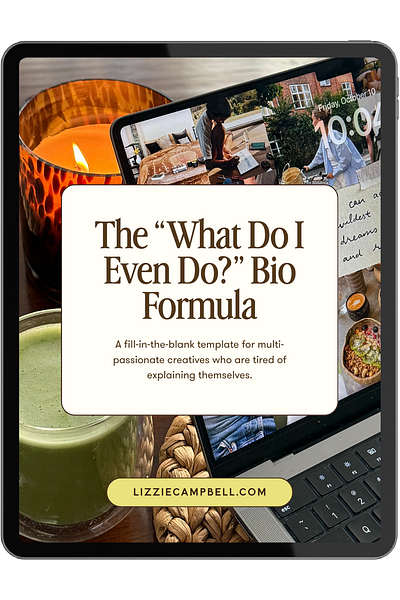
The “What Do I Even Do” Bio Formula is a free fill-in-the-blank workbook with formulas for the three types of bios you should have, plus examples and notes on the most common mistakes multi-passionate creatives make when writing about themselves.
It’s the thing I wish I’d had years ago, before all those awkward networking event conversations.
Work through it all and you’ll have a bio that sounds like all of you – not the flattened, niche-friendly version, not the overwhelming five-minute ramble, but the actual interesting version.
And if you want to go even further and build a complete messaging system for your personal brand (we’re talking elevator pitches, about pages, ideal client personas, social media frameworks, etc.) – The Personal Brand Messaging Toolkit is available now for paid subscribers. Not a member of the club yet? $7/month gets you this, plus everything else we’ve built in there – and everything still to come.
Reading this really helped me claim the title of "writer." For some reason, I still don't feel "legit" enough to call myself a writer. But that's me, that's it. I'm a writer, who helps other writers' build profitable businesses around their work. Thanks for the clarity, Lizzie :)
“I finally realized that the problem wasn’t that I did too many things, necessarily, but that I lacked a way of effectively describing what connected all of my passions, interests, and skills.”
That shift feels important. It’s often not about doing less, but about finding the through-line that makes everything make sense together.